That big, beautiful maple in your front yard could be quietly destroying your sewer line. Tree roots are among the most common causes of sewer trouble we see in Newark, DE — especially in older neighborhoods with mature trees and aging clay or cast-iron pipe. The roots are not attacking your plumbing out of malice; they are simply doing what roots do: growing toward water.
Understanding how roots get in, what the early signs look like, and — critically — why cutting them is only half the job will save you from the most frustrating cycle in residential plumbing: the backup that keeps coming back. Here is the full picture.
Why Roots Invade Sewer Lines
Tree roots grow toward moisture, and a sewer line is a constant, year-round water source. Tiny amounts of water vapor escape through pipe joints, hairline cracks, and loose connections — and root tips can detect that moisture from surprising distances. A root hair finer than a thread slips through the opening, and once inside the pipe it finds exactly what it wants: water and nutrients.
From there the process accelerates. Inside the pipe, the root branches and thickens, forming a dense, fibrous mass. That mass catches toilet paper, grease, and debris flowing past, which is what actually causes the slow drains and backups — the roots are the net, and everything else is what gets caught in it.
Older pipe materials are far more vulnerable. Clay tile lines are built in short sections with a joint every few feet, and each joint is a potential entry point. Cast-iron lines develop cracks and separations as they corrode. Modern PVC lines have fewer, tighter joints and resist root entry much better — but even PVC can be breached at a poorly seated connection.
Signs of Tree Roots in Your Sewer Line
Root intrusion has a distinctive pattern. Watch for these signs, especially if you have large trees anywhere near your sewer lateral (the line running from your house to the street):
Drains that slow down gradually over months
Roots do not cause sudden clogs — they grow. If your drains have been getting progressively slower over a season or more, rather than clogging overnight, roots are a prime suspect. The mass thickens a little at a time, and flow diminishes with it.
Backups that return after snaking
This is the classic signature. A plumber snakes the line, flow is restored, and everything works fine — for a few months. Then the backup returns. Cutting roots with a snake clears the immediate mass, but the roots regrow through the same entry points, and each cycle tends to be shorter than the last.
Gurgling toilets and slow-flushing fixtures
As the root mass disrupts flow, air gets trapped and forced through water in the line — producing the gurgling sounds from toilets and drains that so often accompany root problems. If gurgling shows up alongside gradually slowing drains, roots should be high on the suspect list.
Sinkholes or depressions in the yard
In advanced cases, root pressure can crack or separate pipe sections, letting soil wash into the line. The ground above settles, forming a depression along the pipe's route. If you notice the ground sinking in a line from your house toward the street, get the line inspected promptly.
How Plumbers Confirm Root Intrusion
Symptoms suggest roots; only a sewer camera inspection confirms them. A waterproof camera fed through a cleanout shows the root mass directly — where it enters, how dense it is, and what condition the surrounding pipe is in. That last part matters enormously, because it determines whether the right fix is clearing, lining, or replacement.
The camera also locates the intrusion in feet from the access point, which tells the plumber (and you) exactly which section of pipe is affected and which tree is likely responsible. Without that footage, any root treatment is guesswork.
How Roots Are Removed
Mechanical cutting (drain snake with root blades)
A heavy-duty auger fitted with root-cutting blades is fed into the line to chew through the root mass. This is the fastest way to restore flow and the right first step in most cases. Its limitation is fundamental, though: it cuts the roots but leaves the entry points — the cracks and joints — wide open. Regrowth is a matter of when, not if.
Hydro jetting with root-cutting nozzles
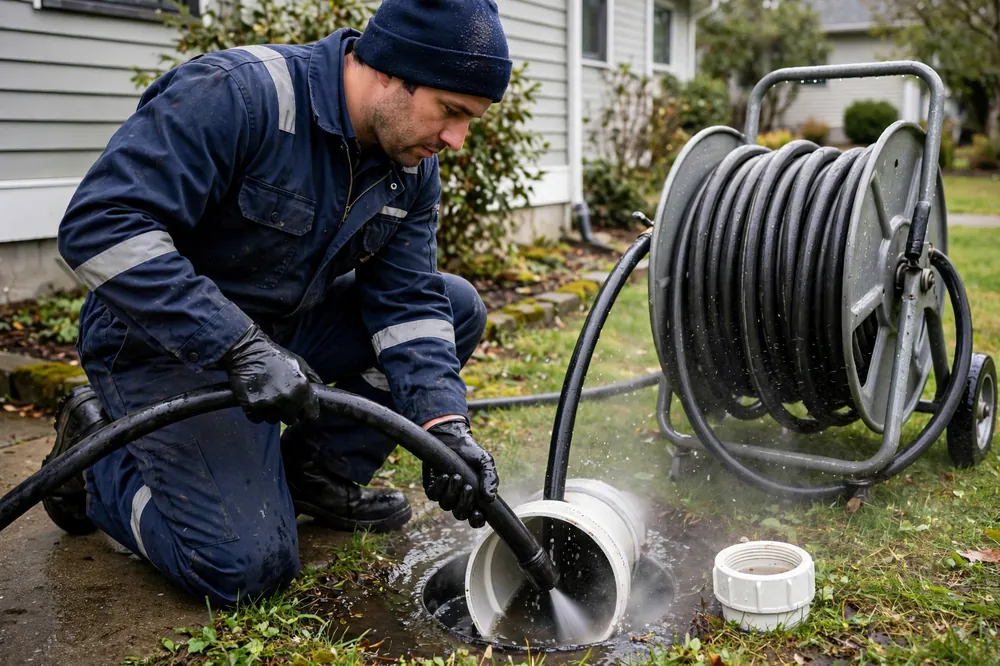
Hydro jetting clears roots more thoroughly than a snake. Specialized nozzles direct high-pressure water to shred the root mass and flush it out of the line, while also scouring the pipe walls clean of the grease and sludge the roots were catching. For heavy root intrusion, jetting is generally the more complete clearing method.
Chemical root treatments
Foaming root killers and copper sulfate products can slow regrowth after mechanical clearing, but they are a supplement, not a solution. They do not remove the existing root mass, they need repeated application, and misused products can harm the tree or the surrounding soil. Think of them as buying time between real fixes — not as the fix itself.
Cutting roots without sealing the pipe is like mowing weeds without pulling them. The visible problem disappears, but the source is untouched — and it always comes back.
The Lasting Fix: Sealing the Pipe
Here is the part many homeowners miss: removing roots treats the symptom. The disease is the openings in the pipe — the joints, cracks, and separations the roots came through. Until those are sealed, you are on a maintenance treadmill of cutting and regrowing.
The lasting fixes address the pipe itself:
- Trenchless pipe lining (CIPP): after the roots are cleared, a resin-saturated liner is installed inside the old pipe and cured in place. The result is a seamless new pipe within the old one — no joints, no cracks, nowhere for roots to enter. This is the most common permanent solution for root-damaged lines that are otherwise structurally intact.
- Pipe bursting: for lines too damaged to line, a new pipe is pulled through the old one, fracturing the old pipe outward. Roots cannot penetrate the new continuous pipe.
- Spot repair or excavation: when damage is localized to one section, that section can be dug up and replaced — sometimes the most economical choice for a single bad joint.
Which option fits depends on the pipe's overall condition, and that is exactly what the camera inspection reveals. A line with roots at every joint is a lining candidate; a line with one bad joint and otherwise sound pipe might just need a spot repair.
Preventing Root Intrusion
If your line is currently root-free — or freshly lined — these steps keep it that way:
- Know where your sewer lateral runs. Your plumber can mark it during a camera inspection. Do not plant new trees on or near that path.
- Choose trees wisely. Fast-growing, water-hungry species — willows, silver maples, elms, poplars — have the most aggressive root systems. If you plant near (not over) the line's vicinity, favor slower-growing species with less invasive roots.
- Respect planting distances. As a rule of thumb, plant large trees at least as far from the sewer line as their expected mature canopy spread — farther for aggressive species. Small ornamental trees and shrubs near the line are far less risky.
- Consider root barriers. Physical root barriers — rigid panels buried vertically between a tree and the line — can redirect root growth downward and away. They work best when installed before roots reach the pipe.
- Inspect older lines periodically. If your home has clay or cast-iron pipe and mature trees nearby, a camera inspection every few years catches root entry while it is still a small, cheap problem.
What To Do If You Suspect Roots
- Do not wait for a full backup. Root masses only grow. A line that is slow today is a line that backs up during the next heavy-use period.
- Get a camera inspection. Confirm roots, locate the intrusion, and assess the pipe's condition — all in one visit.
- Clear the line properly. Snaking restores flow fast; hydro jetting clears more thoroughly. Your plumber will recommend based on severity.
- Fix the pipe, not just the roots. Ask about lining or repair options that seal the entry points. Compare the cost of a permanent fix against the cost of clearing the same line every year or two — the math usually favors the permanent fix.
We serve Newark, Wilmington, Bear, Middletown, and communities across New Castle County. If your drains are slowing and you have trees near your sewer line, call (302) 412-8659 — a camera inspection will show exactly what is happening down there, and we will lay out your options with upfront pricing, from clearing to a lasting main-line fix.