If you run a restaurant, cafeteria, or any commercial kitchen in the Newark, DE area, your grease trap is one of the most important pieces of equipment you never think about — right up until the Friday dinner rush, when the sinks stop draining and the kitchen grinds to a halt. Grease trap maintenance is not glamorous, but it is one of those unglamorous things that keeps a business running.
The most common question we hear from kitchen managers: how often does the trap actually need cleaning? The honest answer is that it depends on your kitchen — but there is a well-established industry guideline for making that decision, and clear warning signs that tell you the schedule needs tightening. This guide covers both.
What a Grease Trap Does (and Why It Matters)
Every commercial kitchen produces fats, oils, and grease — FOG, in industry shorthand — from cooking, dishwashing, and cleaning. When hot grease goes down a drain, it cools as it travels, solidifies, and sticks to pipe walls. Left unchecked, it builds into dense blockages in your own drain lines and, worse, in the municipal sewer downstream.
A grease trap sits in the drain line between your kitchen fixtures and the sewer. It slows the wastewater flow so that grease — which is lighter than water — floats to the top while heavier food solids settle to the bottom. The relatively clear water in the middle layer flows on to the sewer. The trap holds the grease and solids so the sewer does not have to.
This matters for three reasons. First, your own plumbing: a trap that overflows sends grease straight into your drain lines, where it causes the same stubborn blockages residential kitchens get — except at commercial scale. Second, the municipal system: most local sewer programs require commercial kitchens to keep grease out of the public sewer, and many enforce it with inspections and fines. Third, your business: a grease backup during service can close a kitchen for hours or days.
The 25% Rule: The Industry Standard
The widely used guideline across the plumbing and pretreatment industry is straightforward: pump the grease trap before the combined layer of floating grease and settled solids reaches 25% of the trap's liquid capacity. This is often called the 25% rule.
Why 25%? Because a grease trap only works when wastewater has enough clear-water depth to flow through slowly. As grease accumulates on top and solids build up on the bottom, the working depth shrinks. Past about a quarter full of captured material, the trap's efficiency drops sharply — grease starts passing straight through to the sewer, which is exactly what the trap exists to prevent.
In practice, this means there is no universal calendar answer. A busy fry-heavy restaurant might hit 25% in a month. A sandwich shop with light cooking might take three months. The right schedule for your kitchen is the one that keeps you under that threshold — and the only way to find it is to measure.
What Affects Your Cleaning Schedule
Several factors determine how fast your trap fills:
Menu and cooking volume
Frying, grilling, and sautéing produce far more grease than baking or cold prep. A high-volume restaurant with fryers will fill a trap dramatically faster than a coffee shop that mainly washes cups. If your menu changed — say you added fried items — your old pumping schedule may no longer be enough.
Trap size and type
Small under-sink grease traps (common in compact kitchens) hold far less than large in-ground interceptors, so they hit the 25% mark much sooner. An undersized trap for the kitchen's volume is a chronic problem — if the trap needs pumping every two weeks just to stay functional, the trap itself may be too small rather than the schedule too loose.
Kitchen practices
Kitchens that scrape plates into the trash, wipe down greasy pans before washing, and use sink strainers put far less grease and solids into the trap. Kitchens that rinse everything straight down the drain fill it fast. Staff training is genuinely one of the cheapest forms of grease trap maintenance.
Water temperature and detergents
Very hot water and strong degreasing detergents can push liquefied grease through a trap before it has time to separate and float — a phenomenon sometimes called "grease pass-through." This is one reason traps should be sized and serviced properly rather than compensated for with hotter water.
How to Set the Right Schedule for Your Kitchen
Here is the practical method professionals recommend:
- Start with a baseline. Have the trap pumped completely clean, then note the date.
- Measure at intervals. After 30 days, have the grease and solids layers measured (a service tech does this with a simple probe). If you are already near 25%, your interval is monthly or less.
- Adjust. If 30 days puts you well under 25%, try 60 or 90 days and measure again. Settle on the interval that keeps you comfortably below the threshold with margin to spare.
- Re-check seasonally. Holiday rushes, menu changes, and staffing turnover all change grease output. Re-measure a couple of times a year to confirm the schedule still fits.
Many kitchens end up on a monthly, bi-monthly, or quarterly service plan. The key is that the interval is driven by measurement, not by guesswork or by whatever the previous manager set up years ago.
Warning Signs Your Trap Is Overdue
If any of these show up, the trap needs pumping now — and your regular interval is probably too long:
- Slow-draining kitchen sinks that used to drain fine — grease is restricting flow downstream of the fixtures
- Gurgling drains when water is running elsewhere in the kitchen
- Foul odors near floor drains, the trap access, or the dish area — decomposing grease and trapped food waste
- Visible grease in downstream fixtures or in the wastewater leaving the trap
- Backups during peak service — the worst time to discover the trap is full
Treat these as a signal to shorten the service interval, not just to pump once and return to the old schedule.
The cheapest grease trap service is the one that happens on schedule. Emergency pumping during a dinner-rush backup costs more — in service fees and in lost business — than a year of routine visits.
What Professional Grease Trap Service Includes
A proper grease trap cleaning is more than a quick pump-out. A thorough service includes:
- Complete evacuation of the trap's contents — grease, solids, and wastewater — not just skimming the top layer
- Scraping and washing the trap's interior walls, baffles, and lids, where hardened grease accumulates
- Inspecting baffles, gaskets, and the inlet/outlet for damage or deterioration
- Checking flow through the trap after cleaning to confirm it is working properly
- Documentation of the service date and waste disposal — records many local programs require you to keep
Be wary of bargain services that only skim floating grease and leave the settled solids behind. A half-cleaned trap hits the 25% mark again in no time, and you pay for the visit without getting the benefit.
Grease Trap vs. Grease Interceptor
The terms get used interchangeably, but they describe different equipment. A grease trap is a smaller unit, usually installed indoors — under a sink or in a mechanical area — serving one or a few fixtures. A grease interceptor is a large tank, typically buried outside the building, that handles the entire kitchen's wastewater.
Interceptors hold far more volume, so they are pumped less often — but when they are pumped, it is a bigger job requiring a vacuum truck and proper access. Traps are smaller and easier to service but fill faster. Both follow the same 25% principle; only the interval differs. If you are unsure which one your building has, a plumber can identify it in one visit.
Keeping Grease Out of Your Drain Lines
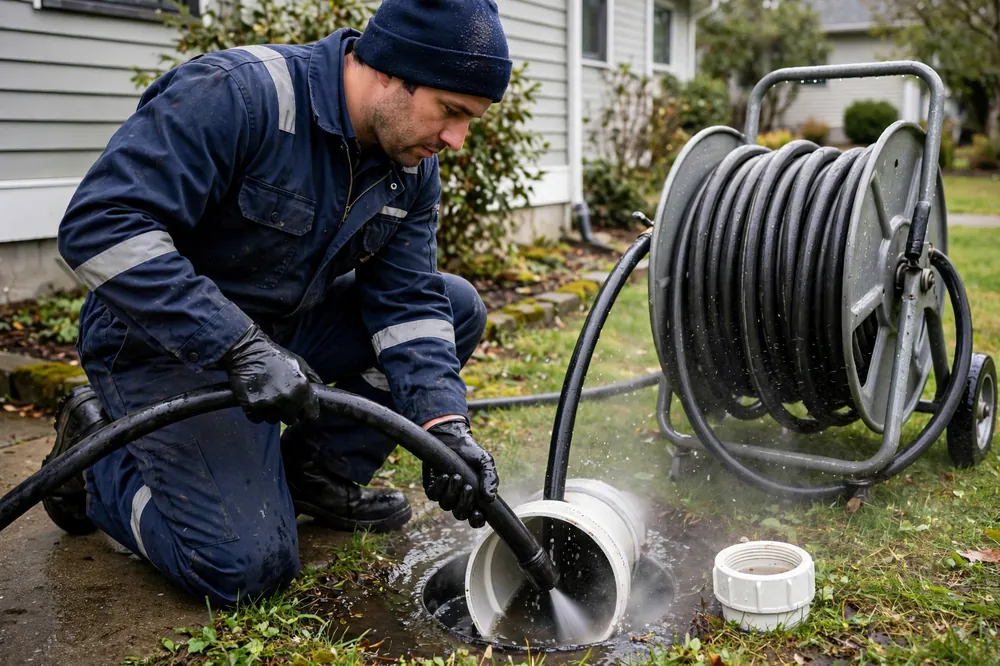
The trap protects the sewer, but your own drain lines between the kitchen and the trap still see plenty of grease. For lines with chronic buildup, periodic hydro jetting scours grease off pipe walls and restores full flow — a smart complement to trap maintenance, especially in older buildings with long kitchen drain runs.
Day-to-day, the biggest difference comes from habits: scrape plates into the trash, wipe greasy pans with paper towels before washing, use sink strainers, and never pour fryer oil down any drain. Used cooking oil should be collected in sealed containers for recycling or proper disposal — many areas have grease recyclers who will pick it up.
Setting Up a Maintenance Plan
The kitchens that never have grease emergencies share one trait: the trap is on a schedule, not on a "we'll call when it smells" basis. A service plan means the trap gets pumped at the right interval, the layers get measured, the baffles get inspected, and you have documentation if the local authority ever asks.
We provide commercial grease trap cleaning for restaurants and kitchens across Newark, Bear, Wilmington, and Middletown. Call (302) 412-8659 to set up a pumping schedule matched to your kitchen's actual grease output — measured, not guessed — with upfront pricing before any work begins.