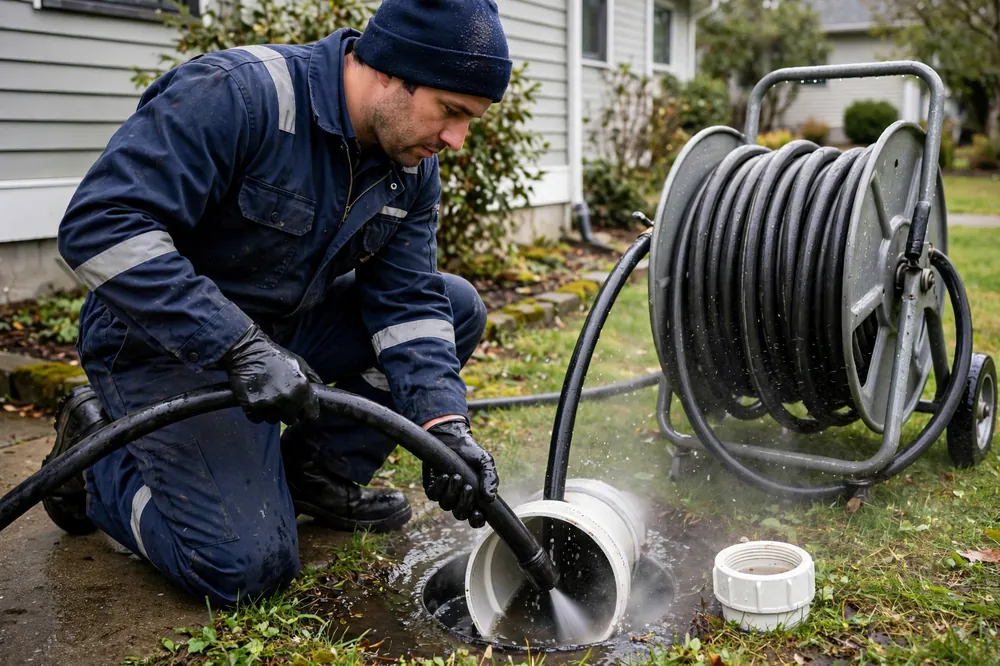
When a drain stops flowing in your Newark, DE home, the fix usually comes down to one of two professional methods: drain snaking or hydro jetting. Both clear clogs. Both are used by plumbers every day. But they work in completely different ways — and choosing the wrong one can mean a clog that comes back in weeks instead of staying fixed.
Here is the short version: a drain snake punches a hole through a blockage. Hydro jetting scrubs the entire pipe clean. That one difference is what decides which method your clog actually needs. This guide explains how each method works, what each one is best at, and how to tell which one will fix your problem for good.
What Is Drain Snaking?
A drain snake — also called a drain auger — is a long, flexible steel cable with a specialized head on the end. A plumber feeds it into the drain, advances it until it reaches the blockage, then rotates it to break the clog apart, bore through it, or latch onto it and pull it back out.
Snakes come in many sizes. A small hand auger or drum machine handles bathroom sinks, tubs, and showers. Larger sectional machines with thicker cables reach 100 feet or more into the main sewer line. Professional machines also use interchangeable heads — spiral cutters for tough clogs, blades for roots, and retriever heads for grabbing objects like toys or rings that fell down a drain.
Snaking is a targeted, mechanical approach. It goes straight to the clog and deals with it. What it does not do is clean the pipe around the clog — after snaking, the pipe walls look the same as they did before, except for the opening the snake cut through the blockage. For a simple, localized clog, that opening is all you need.
The work is usually done through an existing drain opening or cleanout, and a straightforward snaking job is quick and minimally invasive.
What Is Hydro Jetting?
Hydro jetting uses a high-pressure hose fitted with a specially designed nozzle. Water blasts forward to break up the blockage and backward to propel the hose through the pipe — while those rear-facing jets scour the entire interior wall of the pipe as the hose advances. Residential jetting typically runs between 1,500 and 4,000 PSI, with a high flow rate that flushes loosened debris all the way out to the municipal sewer.
The result is more than an open pipe — it is a clean pipe. Grease, sludge, soap scum, and mineral scale get washed off the walls, restoring the pipe close to its original diameter. Different nozzles handle different jobs: penetrating nozzles for dense blockages, spinning or rotating nozzles for grease, and root-cutting nozzles for root intrusion.
Because of the pressures involved, hydro jetting is almost always preceded by a sewer camera inspection. Jetting a cracked, collapsed, or badly corroded pipe can make the damage worse, so a reputable plumber verifies the pipe is sound before the water ever turns on. That inspection also shows exactly what the jetter needs to remove — grease, scale, roots, or a combination.
Drain Snaking: Strengths and Limits
Snaking is the right call for:
- Hair clogs in bathroom sinks, tubs, and showers
- Objects lodged in a trap or branch line — toys, jewelry, bottle caps
- A single clogged fixture when the rest of the house drains fine
- Situations where the pipe's condition is unknown and you want the lowest-risk first step
- Quick clearing when you need the drain working again the same day
Its limits:
- It punches through a clog instead of removing it — grease and sludge coating the pipe walls stay behind
- Cut roots grow back, often within months, because the entry points remain open
- It cannot clean buildup along the full length of a pipe, only the spot the head reaches
- Heavy, hardened scale inside old cast-iron pipe may be too much for a cable to remove
Hydro Jetting: Strengths and Limits
Jetting is the right call for:
- Heavy grease buildup in kitchen lines — the number one repeat-clog culprit
- Sludge and scale coating long runs of pipe
- Recurring clogs that keep returning after snaking
- Tree root intrusion, cleared with root-cutting nozzles
- Preventive maintenance on problem-prone commercial lines, like restaurant drains
Its limits:
- Not appropriate for fragile, cracked, or collapsed pipe — a camera inspection comes first, always
- More equipment, setup, and water use, so it costs more than a simple snaking
- Overkill for a simple hair clog in a bathroom sink
- Needs a proper access point — lines without a cleanout may need one installed first
Snaking vs. Jetting at a Glance
If you like a side-by-side comparison, here is the practical difference:
- What it does: snaking opens a path through the clog; jetting cleans the entire pipe interior.
- Best for: snaking wins on simple, localized clogs (hair, objects, single fixtures); jetting wins on grease, sludge, scale, and repeat clogs.
- Speed: snaking is usually faster to set up and complete; jetting takes longer but the results last longer.
- Risk profile: snaking is the gentlest first step when pipe condition is unknown; jetting requires a camera inspection first to confirm the pipe can take the pressure.
- Cost: snaking is the less expensive option; jetting costs more but often eliminates repeat service calls.
Think of it this way: snaking is like poking a hole in a dam. Jetting is like dredging the whole riverbed. Both let water through — but only one removes the reason it was blocked.
So Which Does Your Clog Need?
Match the method to your symptoms:
Choose snaking when…
- Only one fixture is clogged and the rest of the house drains normally
- The clog is likely hair, soap scum, or a foreign object
- You want the fastest, least invasive fix for a straightforward blockage
- The pipe's condition is unknown and snaking is the safe first step
Choose hydro jetting when…
- Kitchen drains clog repeatedly — that is grease, and grease needs scouring, not poking
- The same drain has been snaked before and clogged again
- Multiple fixtures drain slowly, pointing to buildup in the main sewer line
- A camera inspection shows sludge, scale, or roots coating the pipe walls
- You want a long-term fix rather than a temporary opening
Why Recurring Clogs Point to Jetting
If the same drain has been snaked twice and clogged a third time, the problem is not bad luck — it is residue. Snaking leaves the sticky layer of grease and sludge on the pipe walls, and each new round of debris sticks to it faster than the last. The opening gets smaller, and the interval between clogs gets shorter.
Jetting breaks that cycle by removing the layer itself. With the pipe walls clean, debris has nothing to cling to, and normal water flow keeps the line clear far longer. That is why plumbers recommend hydro-jetting — often paired with a camera inspection — when a drain becomes a repeat customer.
When Neither Method Is Enough
Sometimes the problem is not a clog at all — it is the pipe. A collapsed section, a severe belly (sag) that collects waste, a line offset by shifting soil, or a pipe crushed by root pressure will not be fixed by any kind of clearing. Water will keep pooling in the damaged spot and debris will keep collecting there.
This is exactly what the camera inspection is for. If it reveals structural damage, the answer is repair, not cleaning: trenchless lining for cracks and root entry points, or excavation and replacement for collapsed sections. Clearing first and inspecting is what reveals the difference — and it is far better to learn the pipe is damaged from a camera than from a third failed snaking.
What to Expect During a Service Visit
- Diagnosis. The plumber asks about your symptoms — which fixtures are affected, how long it has been happening, whether it has happened before — and may run a camera down the line to see the actual condition.
- Recommendation. Based on what the camera shows, you get a clear recommendation — snake or jet — with upfront options and pricing before any work begins.
- Clearing. The work is performed through an existing cleanout or drain access. Flow is tested afterward to confirm the line is fully open, and for jetting jobs the camera often goes back in to verify the pipe is clean.
- Prevention advice. You get practical guidance on keeping the line clear, based on whatever caused this particular clog.
Keeping Drains Clear After the Fix
- Never pour grease down the kitchen drain. Wipe pans with a paper towel and throw it away. Grease is the number one cause of repeat kitchen clogs we see in Newark-area homes.
- Use strainers in shower and tub drains to catch hair before it enters the pipe.
- Run cold water before, during, and after using the garbage disposal, and feed food waste in gradually rather than all at once.
- Do not flush wipes — even products labeled "flushable" do not break down like toilet paper and are a leading cause of main-line clogs.
- Consider periodic jetting if you have a line with a history of grease or root problems. Scheduled maintenance costs less than emergency backups.
We serve Newark, Bear, Wilmington, Middletown, and communities across New Castle County. If you are not sure whether your clog needs snaking or jetting, call (302) 412-8659 — describe your symptoms and we will recommend the right fix with an upfront estimate before any work begins.