Water pooling around your feet in the shower. A kitchen sink that takes a full minute to empty. A bathroom sink that gurgles instead of draining. Slow drains are annoying — but they're also useful. A drain that slows down gradually is telling you something is building up inside the pipe, and catching it early is almost always cheaper than dealing with a full backup later.
After years of clearing drains across Newark, Bear, Wilmington, and the surrounding Delaware towns, we've seen the same handful of culprits again and again. Here are the seven most common causes of slow drains, how to identify each one, and what actually fixes it.
1. Hair and soap scum (bathroom drains)
The number one cause of slow bathroom drains is exactly what you'd expect: hair mixed with soap residue. Every shower sheds hair, and bar soap plus hard-water minerals form a sticky film — soap scum — that coats the inside of the pipe. Hair catches on that film, more scum builds on the hair, and the pipe's opening shrinks bit by bit until water can barely get through.
How to tell: Only one fixture is affected — typically the shower, tub, or bathroom sink. The rest of the house drains normally.
What fixes it: A plunger can sometimes dislodge a shallow clog near the drain opening. For deeper buildup, a small hand auger (drain snake) fed through the drain usually pulls the mass out. Avoid pouring chemical cleaners — they rarely dissolve a hair clog completely and can damage older pipes.
2. Grease buildup (kitchen drains)
Cooking grease is liquid when it goes down the drain and solid not long after. It cools, hardens, and sticks to pipe walls, layer after layer. Over months and years, grease narrows the pipe until even dishwater drains slowly. This is the single most common cause of slow kitchen drains we encounter.
How to tell: The kitchen sink is slow but bathroom fixtures are fine. You might notice a faint rancid smell from the drain as trapped food particles decay in the grease.
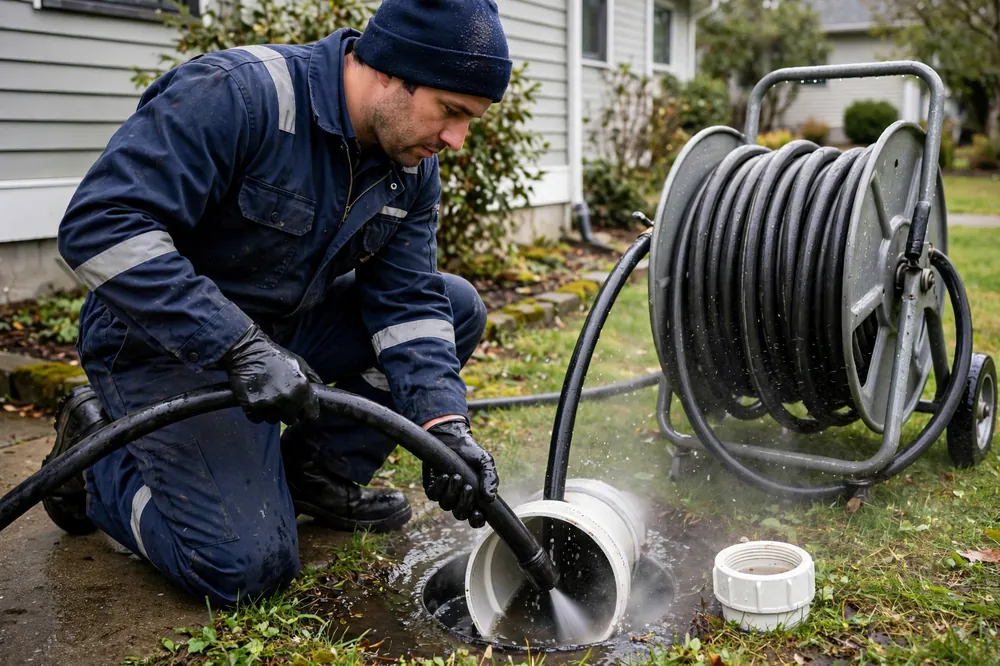
What fixes it: A plumber's snake can punch through a grease clog, but for heavy, long-term buildup, hydro-jetting is the real answer — high-pressure water scours the grease off the pipe walls and restores the full diameter. Going forward, never pour grease down the drain; wipe pans with a paper towel and toss it instead.
3. Food waste and garbage disposal misuse
Garbage disposals are convenient, but they're not trash cans. Fibrous foods (celery, onion skins, corn husks), starchy foods (pasta, rice, potato peels), and coffee grounds don't break down the way people assume. They clump together past the disposal and form dense blockages in the trap or the branch line.
How to tell: The kitchen sink backs up into the other side of a double sink, or the dishwasher drains poorly — both share the same branch line.
What fixes it: Always run cold water before, during, and after using the disposal, and feed food in gradually. For an existing clog, a snake through the trap usually clears it. If backups keep returning, a sewer camera inspection can check whether the problem is further down the line.
4. Tree root intrusion
Tree roots naturally seek out moisture, and a sewer line is a constant water source. Roots enter through tiny cracks or loose joints in the pipe, then grow into a dense mass that catches everything flowing past. This is especially common in older Newark neighborhoods with mature trees and clay or cast-iron sewer lines.
How to tell: Drains slow down gradually over months, not days. You may hear gurgling from toilets, and snaking provides only temporary relief before the problem returns.
What fixes it: Cutting roots with a snake clears the immediate blockage, but roots grow back. Hydro-jetting with a root-cutting nozzle clears them more thoroughly, and a camera inspection shows the pipe's true condition. If the pipe is cracked or collapsed, trenchless pipe lining or excavation and replacement may be the lasting fix.
5. Pipe scale and corrosion
Many Delaware homes still have sections of cast iron or galvanized steel pipe. Over decades, the inside of metal pipe corrodes and develops rough scale — a crusty mineral buildup that shrinks the pipe's interior diameter and snags debris. A 2-inch pipe can end up with the effective opening of a 1-inch pipe.
How to tell: The home is 40+ years old with original plumbing, multiple fixtures drain slowly, and clogs recur in the same spots. Rust-colored water is another clue.
What fixes it: Cast iron pipe descaling uses specialized chain-flail tools to scrape scale off the pipe interior and restore flow — far less disruptive than replacing the pipe. A camera inspection first confirms whether the pipe is a candidate for descaling or needs replacement.
6. Blocked plumbing vent
Every drain system needs air. Vent pipes (usually running up through the roof) let air into the system so water can flow freely. When a vent gets blocked — by leaves, a bird's nest, or ice in winter — air can't get in, and drains slow down or gurgle as they fight for airflow.
How to tell: Gurgling sounds from drains or toilets, especially when another fixture is draining. Sewer odors can also appear because the vent blockage disrupts the trap seals.
What fixes it: Clearing the vent from the roof — carefully, with proper safety precautions. If you're not comfortable on a roof, this is a quick job for a plumber.
7. Main sewer line problems
When every drain in the house is slow — sinks, tubs, toilets, all of them — the problem isn't in any branch line. It's in the main sewer line carrying everything out to the street. Causes include heavy root intrusion, a sagging ("bellied") section of pipe that collects waste, a collapsed section, or a blockage near the municipal connection.
How to tell: Multiple fixtures affected at once. Toilets may bubble when the washing machine drains. Water may back up in the lowest fixture (often a basement floor drain or first-floor tub).
What fixes it: This always needs professional diagnosis. A camera inspection pinpoints the exact location and cause, and from there the fix might be main line clog removal, hydro-jetting, or trenchless repair. Don't ignore this one — a slow main line becomes a sewage backup if left alone.
What you can safely try yourself
For a single slow fixture, these are worth trying before calling:
- Plunger: Use a cup plunger (flat bottom) for sinks and tubs. Seal the overflow drain with a wet rag first so pressure goes into the clog, not out the overflow.
- Remove the stopper: Pop-up stoppers in bathroom sinks collect a shocking amount of hair and gunk. Pull it out and clean it — this alone fixes many slow bathroom sinks.
- Boiling water (metal pipes only): A kettle of boiling water can melt light grease buildup. Never use it on PVC pipes — the heat can soften the joints.
Skip the baking soda and vinegar trick for real clogs. The fizzing looks satisfying, but it doesn't generate enough force to clear an actual blockage — it's fine as a mild deodorizer, not a drain opener.
When to call a plumber
Call Express Drain Rescue at (302) 412-8659 when:
- More than one fixture is slow or backing up
- You hear gurgling from toilets or drains
- Water backs up in a different fixture than the one you're using
- There's a sewage smell coming from any drain
- The same drain keeps clogging after you've cleared it
- You see water pooling around a basement floor drain
We serve Newark, Bear, Wilmington, Middletown, and communities across New Castle County — with same-day appointments and upfront options before any work begins.