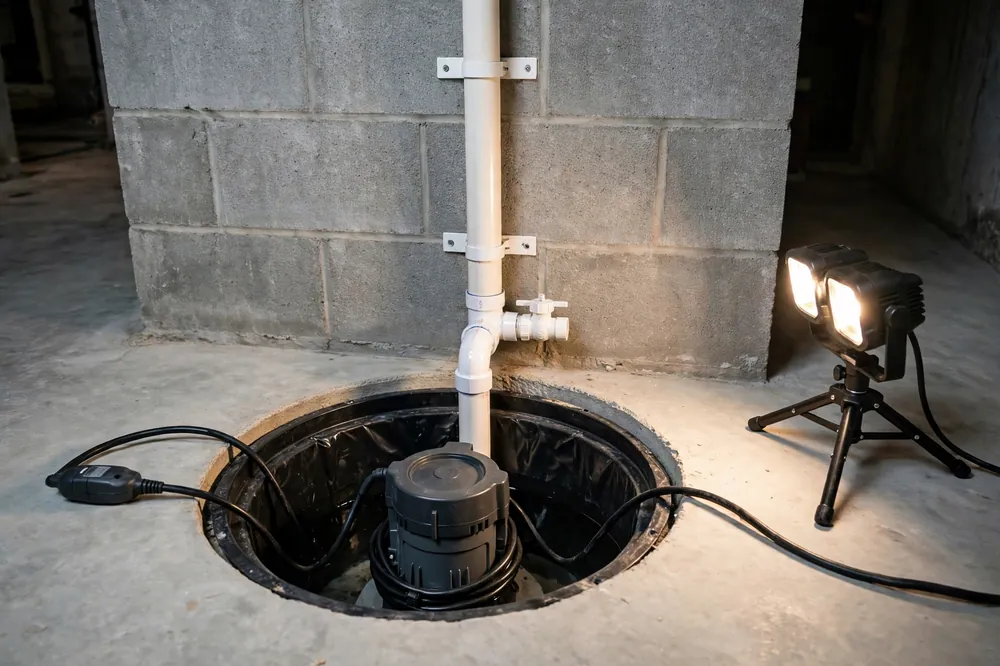
Your sump pump is the hardest-working piece of equipment in your home that you never think about. It sits in a dark pit in the corner of your basement or crawl space, silent for weeks at a time — right up until the moment it's the only thing standing between your home and several inches of groundwater. That's the cruel irony of sump pumps: when they fail, they fail quietly, and you usually discover it during the storm, the spring thaw, or the week of relentless rain when you needed them most.
In Newark and across New Castle County, basement water is a fact of life. The water table runs high in many neighborhoods, clay-heavy soil drains slowly, and nor'easters can dump inches of rain in a single day. If your home has a sump pump, it isn't a luxury — it's part of your foundation's defense system. The good news is that pumps rarely die without warning. Here are the six signs yours is telling you it's in trouble, plus a simple test you can do this weekend.
1. The pump runs constantly — or cycles on and off every few seconds
A healthy sump pump runs in cycles: water collects in the pit, the float switch rises, the pump kicks on, the pit drains, and the pump shuts off. If yours never seems to shut off, something is wrong. It could be a float switch stuck in the "on" position, a check valve that has failed and is letting discharged water flow right back into the pit, or a pump that's undersized for the amount of water your foundation takes on. Constant running burns out motors fast — a pump that runs nonstop is a pump with a dramatically shortened life.
The opposite problem — short-cycling, where the pump kicks on and off every few seconds — is just as bad. That's often a float switch with too narrow a range, a pit that's too small for the inflow, or a check valve issue causing water to slosh back down the discharge pipe. Both patterns waste electricity and wear out the pump, and both are fixable once you know the cause.
2. Strange noises: grinding, rattling, or loud humming
Sump pumps aren't silent, but you learn what yours normally sounds like — and new noises are a red flag. Grinding or rattling often means debris like gravel, sediment, or small stones has gotten into the pump intake and is chewing up the impeller. A loud, strained humming with no water moving can mean the motor is jammed or the impeller is stuck. Gurgling from the discharge pipe can signal a failing check valve that's letting water fall back into the pit.
Don't ignore the soundtrack. Unusual noises mean internal parts are wearing or damaged, and a pump making bad noises during dry weather may not survive the next heavy rain. Start by cleaning the pit and the intake screen — sediment buildup alone can cause rattling. If cleaning doesn't quiet it down, have the pump inspected before it quits on you.
3. It doesn't respond when water rises
This is the big one — and the reason to test your pump before you need it. Pour a bucket of water into the pit (there's a step-by-step test below). The float should rise and the pump should kick on promptly. If nothing happens, the float switch may be stuck, tangled, or broken; the power connection may have failed; or the motor itself may be dead.
Sometimes the fix is simple — a float switch wedged against the side of the pit or tangled in the pump's own power cord is a classic. Sometimes the pump is just done. Either way, a pump that won't turn on when water rises is a pump that has already failed — you just haven't had the flood yet.
4. Visible rust, corrosion, or an aging pump
Take a flashlight and look at your pump. Surface rust on a cast-iron housing is common and not always fatal, but heavy corrosion, flaking metal, or rust around electrical connections is a sign the pump is deteriorating from the inside out. Check the power cord too — cracked or brittle insulation near a wet pit is a safety issue, not just a reliability one.
Also consider age. Sump pumps are mechanical devices with moving parts, seals, and switches that wear out. If your pump is old enough that you can't remember when it was installed — or it came with the house and you've lived there for many years — treat it as suspect. Pumps sitting in pits with iron-heavy or sediment-laden water wear out faster. When in doubt, a professional can tell you whether the pump has life left or is running on borrowed time.
5. The pump vibrates, tilts, or wanders around the pit
A sump pump should sit level and stable on the bottom of the pit. If yours vibrates heavily, leans to one side, or has actually moved from where it was installed, something is off. Heavy vibration often means a damaged or unbalanced impeller — sometimes from debris passing through, sometimes from plain wear. A pump that has tipped over can jam its own float switch against the pit wall, which means it can't turn on (or can't turn off).
Check that the pump is sitting flat and that the intake isn't clogged with silt — a surprising number of "failing" pumps are just sitting crooked in a silted-up pit. If the vibration persists after cleaning and repositioning, the impeller or bearings are likely worn, and replacement is usually the sensible call rather than a repair.
6. It keeps tripping the circuit breaker
A sump pump that trips its breaker is telling you the motor is drawing too much current — usually because it's straining. Common causes include a jammed impeller, a motor failing internally, or a wiring problem. Resetting the breaker and hoping for the best is not a plan: every trip is stress on the motor, and a breaker that trips during a storm leaves you with no pump at all.
If the pump trips the breaker more than once, unplug it and call a professional. This is also a good reminder that your sump pump should be on a dedicated circuit — sharing a circuit with freezers, dehumidifiers, or other basement loads makes nuisance trips more likely and can mask a real motor problem.
Test your sump pump in under five minutes
You don't need any tools — just a bucket of water and a flashlight. Run this test a few times a year, and always before storm season:
- Check the power. Make sure the pump is plugged in and the outlet is live. Pumps get unplugged for basement projects and never plugged back in — it happens more often than you'd think.
- Inspect the pit. Clear debris, gravel, and silt from around the pump and the float switch. Lift the float by hand and make sure it moves freely up and down without catching.
- Pour water in. Slowly pour a bucket or two of water into the pit until the float switch rises. The pump should kick on without hesitation.
- Watch it work. The pump should drain the pit steadily and then shut off. Listen as it runs — you should hear water moving up and out, not gurgling back down through a bad check valve.
- Check the discharge. Go outside and confirm water is actually exiting the discharge pipe well away from your foundation — not pooling against the house or blocked by a frozen outlet in winter.
If your pump passes all five steps, you're in good shape. If it fails any of them, you now know exactly what to describe when you call — and you've caught the problem on a dry day instead of during a storm.
Consider a battery backup before the next big storm
Here's the flaw no sump pump can fix on its own: it needs electricity, and the storms that flood basements are the same storms that knock out power. A battery backup sump pump sits beside your main pump and takes over automatically when the power goes out — or if the main pump itself fails. It won't run forever on a charge, but it covers the outage window when most flood damage happens.
If your basement is finished, stores valuables, or has flooded before, a backup system is one of the smartest upgrades you can make. For most Newark homes, a battery backup paired with a healthy primary pump is the reliable combination. We install sump pump systems — including battery backups — across Bear, Wilmington, and the surrounding area.
When to call a plumber
Call Express Drain Rescue at (302) 412-8659 when:
- Your pump fails the bucket test or won't turn on
- The pump runs constantly or short-cycles
- You hear grinding, rattling, or strained humming
- The breaker trips whenever the pump runs
- The pump is old, corroded, or you don't know its age
- You want a battery backup installed before storm season
And if your basement takes on water even with a working pump, the issue may be the drainage around your foundation rather than the pump itself — a French drain system or exterior drainage work can reduce the water load the pump has to handle. A quick inspection tells us which fix your home actually needs, and you'll get upfront options before any work begins.