After a heavy Delaware rain, you walk downstairs and find water where it should not be — a damp corner, a puddle along the wall, or a floor drain doing nothing while water spreads across the floor. The internet will tell you to get a French drain. Your neighbor swears by their sump pump. A contractor quotes you for both. Which one do you actually need?
The confusion is understandable, because these two systems are talked about as alternatives when they are really designed to do different jobs — and they often work best together. This post breaks down what each system does, which water problems each one solves, and how to figure out what your basement is asking for.
What a French drain does
A French drain is a passive drainage system: a perforated pipe buried in a trench filled with gravel. Groundwater flows through the gravel, enters the pipe through the perforations, and the pipe carries it away by gravity. There are no moving parts and nothing to plug in — it works around the clock, silently, for as long as the pipe stays clear.
French drains come in two main placements, and the distinction matters:
Exterior French drain
Installed around the outside of the foundation, below the level where water enters. It intercepts groundwater before it ever reaches your foundation walls and redirects it away from the house — to a dry well, a storm drain, or a downhill discharge point. This is the most thorough way to keep water off the foundation, but it requires excavating around the house, which is the most disruptive and expensive version of the job.
Interior French drain
Installed inside the basement, along the perimeter where the floor meets the wall. A trench is cut into the slab around the edge of the floor, the perforated pipe and gravel go in, and the floor is patched back over it. Water that seeps in through the wall-floor joint or up through floor cracks drops into the drain instead of spreading across the floor. It is far less disruptive to install than an exterior drain, and it handles the most common basement water entry points.
The key limitation of any French drain: it collects and channels water, but it does not lift it. If the discharge point is above the drain — which it almost always is for an interior system — the water needs a pump to get it up and out. That is where the sump pump comes in.
What a sump pump does
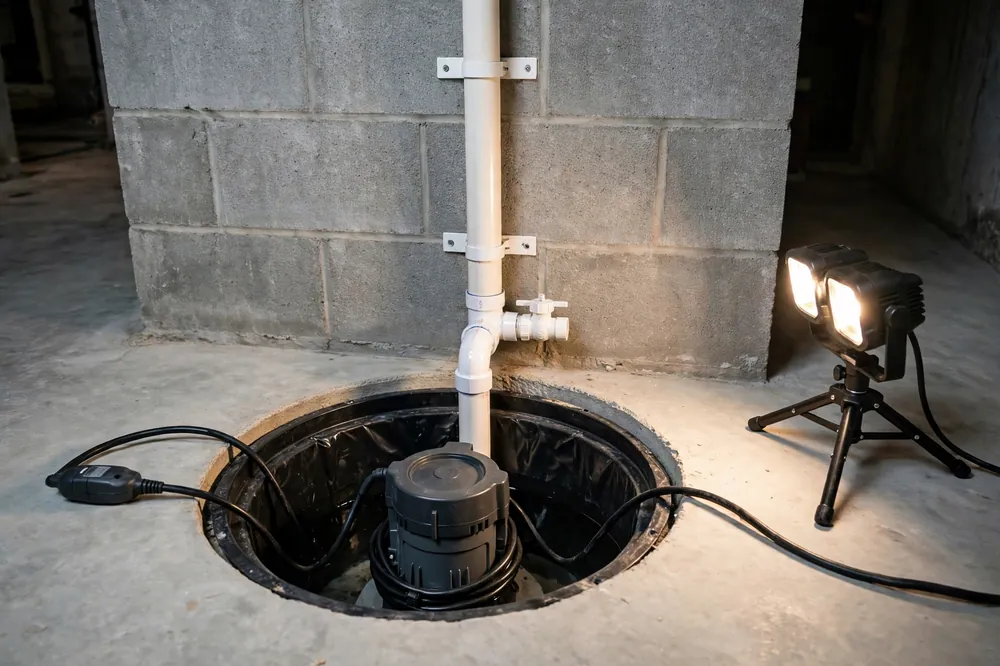
A sump pump is an active mechanical device that sits in a pit (the sump basin) dug into the lowest part of the basement floor. When water flows into the pit and rises to a trigger level, a float switch turns the pump on, and it pushes the water up through a discharge pipe and out of the house — typically to the yard, well away from the foundation.
A sump pump installation includes the pit, the pump, the discharge line, and usually a check valve on the discharge pipe so water cannot flow back into the pit when the pump shuts off. Many homeowners also add a battery backup, because the storms that cause the worst flooding are the same storms that knock out power.
The pump's limitation is the mirror image of the French drain's: it can only pump water that reaches its pit. A lone sump pump in one corner does nothing for water entering at the opposite end of the basement. It needs a collection system feeding it — which is exactly what a French drain provides.
They solve different problems
Think of it this way: the French drain is the collection network, and the sump pump is the exit. One gathers water from around the foundation; the other ejects it from the house. Here is how they compare side by side:
- How it works: French drain moves water passively by gravity through a perforated pipe; sump pump moves water actively with an electric motor.
- Power needed: French drain needs none; sump pump needs electricity (and ideally a battery backup for outages).
- What it fixes: French drain handles groundwater seeping through walls, the wall-floor joint, and floor cracks; sump pump handles water that has already collected in the pit, including water the drain delivers.
- Maintenance: French drain needs occasional flushing to prevent silt buildup; sump pump needs periodic testing — pour water in the pit and confirm it kicks on — plus float switch and check valve checks.
- Failure mode: French drain can clog with silt or roots over many years; sump pump can fail from a stuck float, a burned-out motor, or a power outage.
Notice that these are complementary, not competing. The standard professional solution for a chronically wet basement is an interior French drain feeding a sump pit with a pump — the drain collects from the whole perimeter, and the pump removes it. Asking "which one" is often the wrong question; the right question is "what is my water doing, and what combination stops it."
Reading your basement: which problem do you have?
Before choosing a fix, diagnose the water. Different entry patterns point to different solutions:
Water seeping at the wall-floor joint or through wall cracks
This is groundwater under hydrostatic pressure — water in the soil pushing against and under your foundation. It is the most common basement water problem in our area, and the textbook solution is an interior French drain system around the perimeter feeding a sump pump. The drain relieves the pressure at the joint, and the pump removes the collected water.
Water coming up through floor cracks in the middle of the slab
This means the water table under the house is rising above the floor level during wet periods. An interior French drain plus sump pump is again the standard answer — the drain intercepts the water under the slab and the pump keeps the level down. Exterior waterproofing alone will not fix this, because the water is coming from below.
Water running down walls from above
Water entering high on the wall — or damp walls with white mineral stains (efflorescence) — suggests surface water running against the foundation: overflowing gutters, downspouts dumping at the foundation, or yard grading that slopes toward the house. Fix the surface water first — extend downspouts, regrade, clean gutters — because no interior system should have to handle a waterfall. If the wall itself is compromised, an exterior French drain or exterior waterproofing membrane may be warranted.
A one-time flood vs. a chronic problem
A basement that floods once during an extreme storm is different from one that gets damp every rainy season. A single event might be addressed with a sump pump as insurance. A chronic problem — dampness, musty smell, and visible seepage several times a year — deserves the full interior drain-and-pump system, because the water is telling you it will keep coming.
Start with the cheapest fixes first: clean gutters, extend downspouts at least several feet from the foundation, and check that the yard slopes away from the house. If water still gets in after the surface water is handled, the problem is groundwater — and that is what French drains and sump pumps are for.
Why many Newark-area homes end up with both
In our service area, the complete system we install most often is exactly the pairing this post describes: an interior French drain around the basement perimeter, draining into a sump pit with a primary pump and a battery backup. Here is why the combination wins:
- Full coverage: The drain collects water from the entire foundation perimeter, not just the one spot where a pit happens to be.
- Pressure relief: By giving groundwater an easy path into the drain, the system relieves the hydrostatic pressure that pushes water through the wall-floor joint.
- Redundancy: The battery backup keeps the pump running when storms knock out power — which is precisely when you need it most.
- Proven track record: This is the standard approach basement waterproofing professionals use because it addresses the physics of the problem rather than one symptom.
A sump pump without a drain is a partial solution. A French drain without a pump is an unfinished one. Together, they are a system.
Choosing the right fix for your situation
Here is a practical decision guide:
- Handle surface water first. Gutters, downspouts, and grading are the cheapest fixes and solve a surprising number of "wet basement" complaints.
- Seepage at the wall-floor joint or through the floor? Plan on an interior French drain plus sump pump.
- Water running down walls from above? Look at exterior solutions — grading, downspout extensions, or an exterior French drain.
- Already have a sump pump but still get water? You likely need the collection side of the system — a French drain feeding the pit.
- Get an on-site assessment. Every foundation, soil condition, and water pattern is different. A professional inspection matches the fix to the actual problem instead of guessing.
When to call Express Drain Rescue
Call us at (302) 412-8659 if:
- Your basement gets water during or after rain
- You have a sump pump but water still finds its way in
- You see efflorescence, damp spots, or a musty smell in the basement
- You want a French drain, a sump pump, or the complete system installed
- Your existing sump pump is old, noisy, or untested
We serve Newark, Bear, Middletown, and communities across New Castle County — with drainage assessments that identify where your water is coming from and upfront options for the fix that actually fits.